Technical starting point
Silicon revision, board schematics, firmware baseline, expected measurements and lab access.

POST-SILICON VALIDATION
Measure real-device behaviour against functional, performance and power requirements.
Discuss your requirements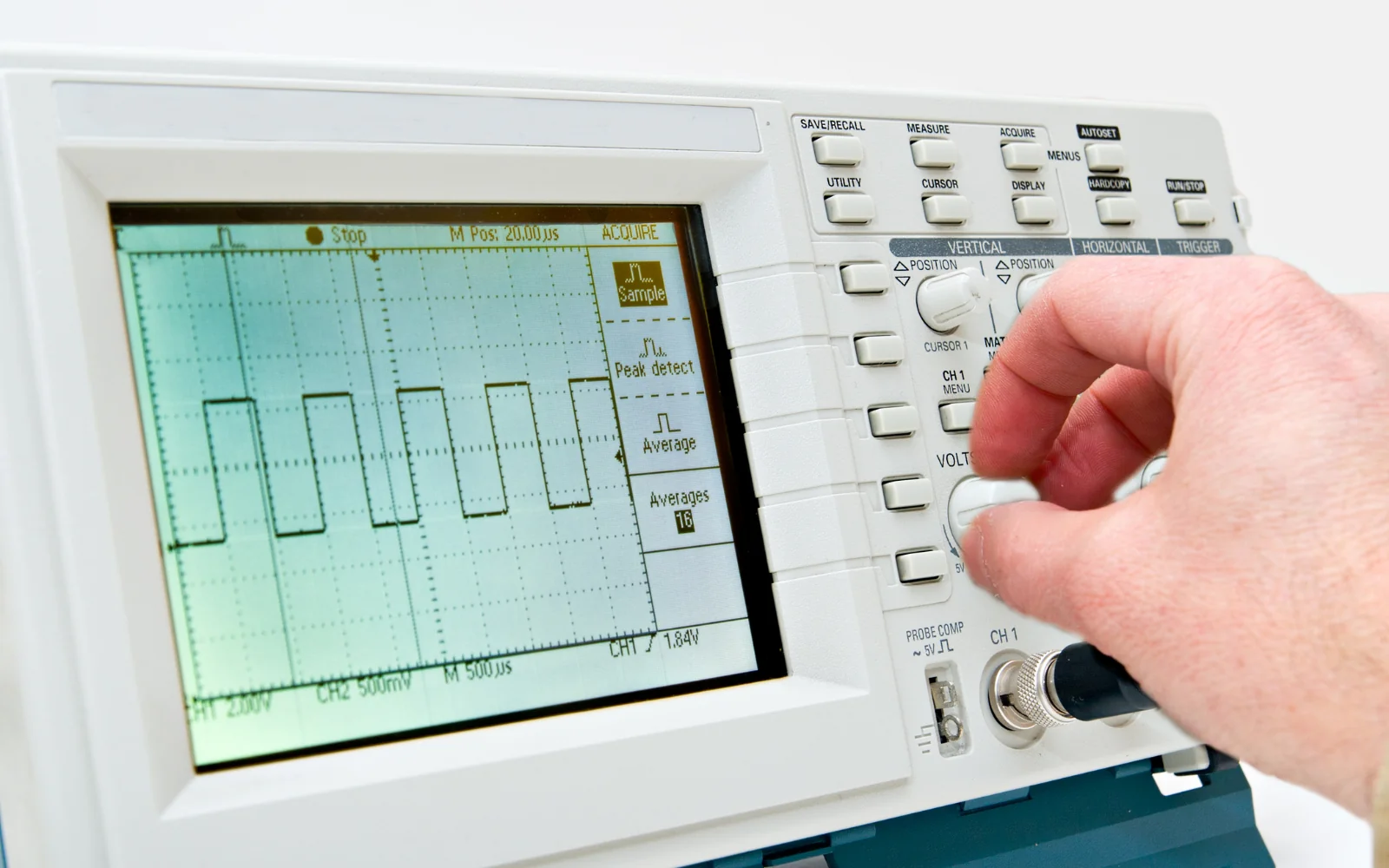
Representative photograph · Engineer adjusting an oscilloscope displaying a digital waveform.
THE ENGINEERING SCOPE
Silicon revision, board schematics, firmware baseline, expected measurements and lab access.
Repeatability, voltage/frequency boundaries, workload coverage and instrument configuration.
Validation scripts, measurement data, issue reproductions and characterisation summaries.
CLIENT GUIDE
Use these technical checkpoints to make the first project review productive.
HOW WE WORK
The initial review establishes the baseline using silicon revision, board schematics, firmware baseline, expected measurements and lab access. Record gaps and dependencies before implementation.
Carry out the agreed work against the reviewed baseline. For post-silicon validation, keep the interfaces and configuration used by this stage visible to the receiving team.
Retain the intermediate artifacts and review repeatability, voltage/frequency boundaries, workload coverage and instrument configuration. Investigate failures before using these results as an input to the next stage.
Package validation scripts, measurement data, issue reproductions and characterisation summaries. Review unresolved findings against the agreed acceptance criteria and assign ownership for follow-up.
PROJECT DECISIONS
Use these gates to agree readiness, review evidence and responsibility at each stage.
Are the starting inputs complete enough to proceed?
Silicon revision, board schematics, firmware baseline, expected measurements and lab access.
Record input revisions, missing material and who can resolve each dependency.
Has the work addressed the agreed technical objective?
Measure real-device behaviour against functional, performance and power requirements.
Keep the intermediate artifacts with review comments and the decisions that changed the design.
Can the result be reproduced and interpreted?
Repeatability, voltage/frequency boundaries, workload coverage and instrument configuration.
Capture the configuration, expected result, observed result and unresolved findings.
Can the receiving team use the delivery package?
Validation scripts, measurement data, issue reproductions and characterisation summaries.
Review build or execution instructions, known limitations and ownership of follow-up actions.
INPUTS & OUTPUTS
The final statement of work defines the scope and acceptance criteria.
TECHNICAL DECISIONS
Measure real-device behaviour against functional, performance and power requirements.
The work starts from silicon revision, board schematics, firmware baseline, expected measurements and lab access. The team should identify the authoritative revision of each input and record any assumptions needed to proceed. This prevents a later result from being interpreted against a different specification or configuration.
Separate a silicon defect from firmware, board and measurement effects before deciding on corrective action.
The review centres on repeatability, voltage/frequency boundaries, workload coverage and instrument configuration. Each finding should identify the input revision, observed behaviour and supporting evidence. Distinguish a confirmed defect from a configuration issue, an unsupported case or an open engineering question before deciding how to resolve it.
The practical sequence is: establish safe bring-up; validate basic functions; characterise operating points; triage differences from expected behaviour. Intermediate reviews allow the client to resolve decisions while changes are still manageable. If an input changes, identify the affected activities and repeat the checks that depend on it.
The expected package comprises validation scripts, measurement data, issue reproductions and characterisation summaries. Acceptance criteria should specify what the receiving team needs to reproduce, inspect or integrate these artifacts. Include known limitations and outstanding actions in that package, rather than assuming that delivery of a file implies acceptance.
A specification becomes useful when the team can distinguish legal behaviour from a defect at each interface. Record which side drives a transaction, when data becomes valid, how backpressure works and what happens if reset arrives during a transfer. Register descriptions should state access permissions, reset values and side effects. Configuration parameters need a supported range; a design verified in one configuration should not automatically be treated as verified in every configuration.
Performance requirements need a workload and an observation point. Specify whether a latency target measures an isolated transaction or a stream under contention. State how throughput is counted when requests stall, retry or cross clock boundaries. This makes architecture reviews more productive: a buffer, pipeline stage or arbitration change can be compared against an explicit requirement rather than a headline frequency.
Keep functional verification, structural checks and implementation feasibility as distinct review activities. A successful compile, proof or synthesis run answers the question posed by its setup; it does not establish that the setup covered the entire product requirement. Review assumptions, exclusions and unsupported modes alongside the result. Where an interface is supplied by another team, agree a small integration test and its expected response before connecting the full subsystem.
Consider a producer that can issue consecutive requests while its consumer occasionally stalls. Review whether the interface preserves ordering, holds data stable and resumes without losing a request. Add a reset during the stall and a boundary-length transfer. Record the expected behaviour first, then retain the test and result with the design revision. This is an illustrative review scenario, not a claim about a delivered client project.
BEFORE WE BEGIN
A clear conversation is the start of a strong engineering relationship.
The starting review needs silicon revision, board schematics, firmware baseline, expected measurements and lab access. Share the current revision and known limitations so the scope reflects the actual design state.
The statement of work can define validation scripts, measurement data, issue reproductions and characterisation summaries. The final package should include review results and any open actions.
Separate a silicon defect from firmware, board and measurement effects before deciding on corrective action.
The first work package can be a review of the available inputs and the engineering questions that must be resolved. Agree its boundaries, access requirements and expected findings before committing to a larger implementation. A review should leave an actionable list of decisions, dependencies and next steps.
Tie each finding to the relevant revision and supporting evidence. A change should identify the affected interfaces, activities and checks. Confirm its effect on scope and delivery with the responsible owner. At handoff, distinguish closed findings, accepted limitations and open work so that a file transfer is not mistaken for technical acceptance.
PUT THE WORKFLOW IN CONTEXT
Practical reading to help prepare your project discussion. Studies are illustrative; they do not report client results.
Finding the gaps in a reset verification plan ↗YOUR NEXT CHAPTER STARTS HERE
Bring us your engineering challenge.
Let’s define the path from idea to implementation.